
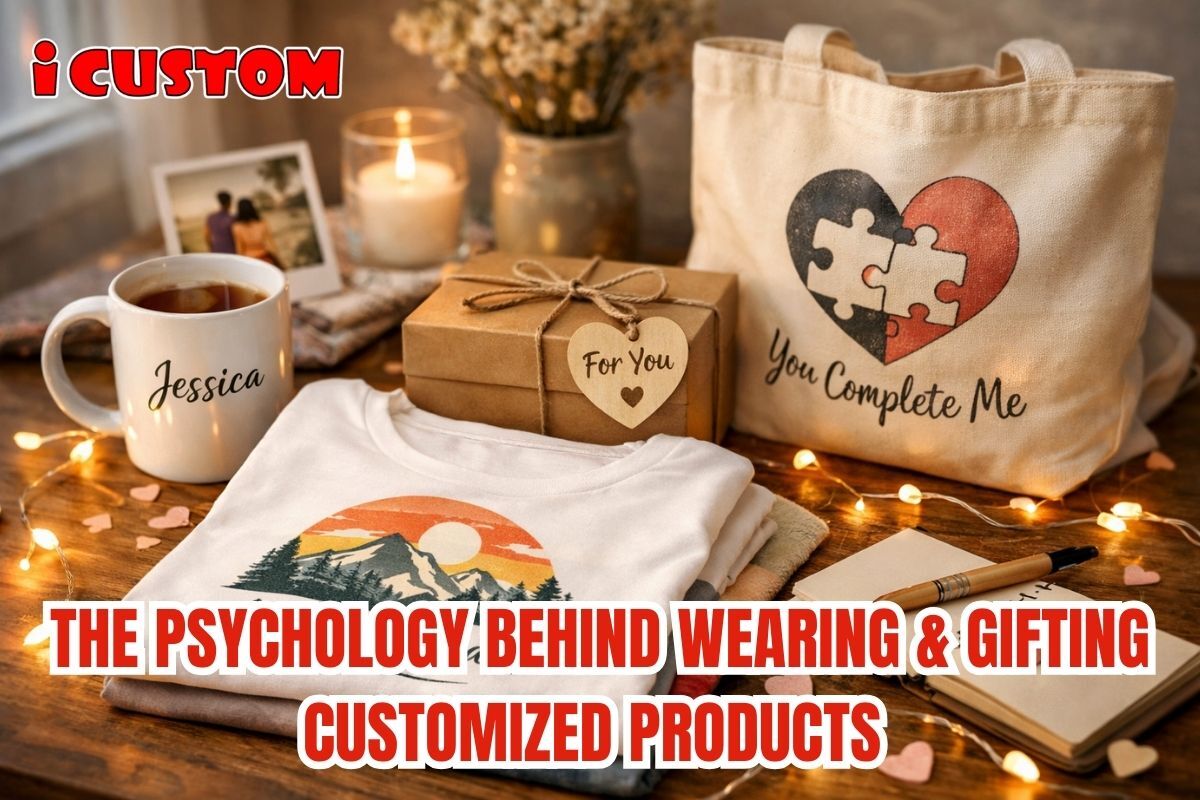
(And Why People Love Them)
People rarely buy customized products just because they “look nice.”
They buy them because those products feel personal.
A custom t-shirt, a hoodie with meaning, a photo mug, a personalized hat, or even a simple sticker often carries more emotional weight than an expensive generic item. This isn’t accidental—it’s psychological. Custom products tap into deep human needs like identity, memory, belonging, and self-expression.
While most custom-printing websites focus on products and prices, very few talk about why customization works so well on the human mind. Understanding this psychology explains why personalized items consistently outperform generic gifts, why people keep them longer, and why they feel emotionally attached to them.
This essay explores the psychological reasons people love customized products, how they influence behavior, and why custom apparel and gifts have become such powerful tools for both personal expression and branding.
At the core of customization lies one powerful idea: identity.
Humans are wired to express who they are—what they believe, where they belong, and what matters to them. Clothing and personal items have always been tools for this expression, long before modern branding existed.
A custom t-shirt doesn’t just cover the body.
A hoodie doesn’t just provide warmth.
A hat isn’t just an accessory.
When these items are personalized, they become symbols of identity.
A quote reflects beliefs
A logo reflects affiliation
A design reflects taste
A name reflects ownership
Psychologically, wearing something customized sends a silent message:
“This is mine. This represents me.”
That sense of ownership and self-representation is deeply satisfying. It explains why people feel more confident wearing custom apparel than generic fashion—it aligns with their internal identity.
People are far less likely to discard customized products than generic ones. This is not about material quality—it’s about emotional attachment.
A photo mug with a memory on it is not just a mug.
A hoodie with a meaningful design is not just clothing.
These items trigger emotional recall.
Psychologically, the brain links objects with experiences. When a product carries a memory—like a family moment, a milestone, or an inside joke—it becomes emotionally anchored. Losing or replacing it feels like losing a part of that memory.
This is why:
Personalized gifts are kept longer
Custom apparel becomes “favorite” clothing
People hesitate to throw away customized items
The emotional value often exceeds the monetary value—and that is why customized products feel special.
The human brain loves stories, and customized products often hold stories silently.
A photo mug can remind someone of:
A birthday
A loved one
A trip
A life phase
A custom t-shirt can recall:
A reunion
A first job
A team or group
A personal achievement
From a psychological standpoint, these items act as memory cues. Even a quick glance can trigger emotions tied to the past. This is why people smile unconsciously when they see certain customized items—they are reliving a moment without realizing it.
Generic products rarely do this. Custom ones almost always do.
One of the strongest human needs is belonging. Custom apparel and merchandise satisfy this instinct beautifully.
Matching t-shirts for families, teams, gyms, or businesses create a visible sense of unity. Wearing the same design communicates:
Inclusion
Loyalty
Shared purpose
This is why custom hoodies work so well for gyms, clubs, and groups. It’s also why branded hats and stickers help communities and businesses feel connected beyond physical spaces.
From a psychological angle, belonging reduces anxiety and increases confidence. Custom products silently reinforce that sense of “we” rather than “me.”
Not everyone likes to speak loudly—but everyone expresses something.
Customized products allow people to communicate without words. A sticker on a laptop, a design on a hoodie, or a slogan on a t-shirt can express:
Humor
Values
Creativity
Beliefs
Psychologists refer to this as non-verbal self-expression. People often feel safer expressing parts of themselves through objects rather than conversations. Custom printing enables this in a socially acceptable, everyday way.
This is especially powerful for younger audiences, creators, and introverts—who often prefer visual expression over verbal explanation.
From a gifting psychology perspective, personalized items consistently outperform generic ones. The reason is simple: effort signals care.
When someone receives a customized gift, the brain interprets it as:
“They thought about me.”
“This wasn’t rushed.”
“This was made for me.”
Even if the item itself is simple, the personalization elevates its perceived value. This is known as effort justification—the idea that effort increases emotional appreciation.
A generic gift can be useful.
A personalized gift feels meaningful.
That difference explains why photo mugs, custom apparel, and personalized accessories dominate gifting occasions.
For businesses, custom merchandise works because of repeated exposure.
Seeing the same logo or design on:
T-shirts
Hoodies
Mugs
Stickers
creates familiarity. Psychologically, familiarity breeds trust. This is known as the mere exposure effect—the more often people see something, the more positively they feel about it.
This is why custom branding across multiple products strengthens recognition without aggressive marketing. It feels natural rather than promotional.
Another overlooked psychological factor is control.
Customization gives customers creative involvement. They are not just buying—they are creating. Choosing colors, placement, and designs activates a sense of agency and satisfaction.
Psychologically, people value things they help create more than things they simply purchase. This is why customized products often feel more “valuable” to the buyer, even when the price difference is small.
Platforms like icustomca.com thrive here by making customization accessible—turning customers into collaborators rather than passive buyers.
Stickers may look simple, but psychologically they are powerful.
They allow:
Personalization without commitment
Easy identity signaling
Low-cost self-expression
Placing a sticker on a phone, bottle, or laptop is a form of claiming space. It says, “This object reflects me.” That sense of personalization increases attachment to everyday items.
The beauty of customized products is that they don’t need aggressive selling. The emotional pull does the work.
People don’t ask:
“Do I need this?”
They ask:
“Why does this feel so right?”
That emotional alignment leads to higher conversion rates, repeat purchases, and long-term loyalty—without pushy tactics.
At its core, the popularity of custom apparel and personalized gifts has little to do with fashion or printing technology. It has everything to do with human psychology.
People love customized products because they:
Reflect identity
Preserve memories
Strengthen belonging
Enable self-expression
Signal care and effort
Whether it’s a custom t-shirt, hoodie, photo mug, personalized hat, or a simple sticker, these items succeed because they connect emotionally.
In a world flooded with mass-produced goods, customization feels human.
And that is why people don’t just buy custom products—they keep them, wear them, and treasure them

